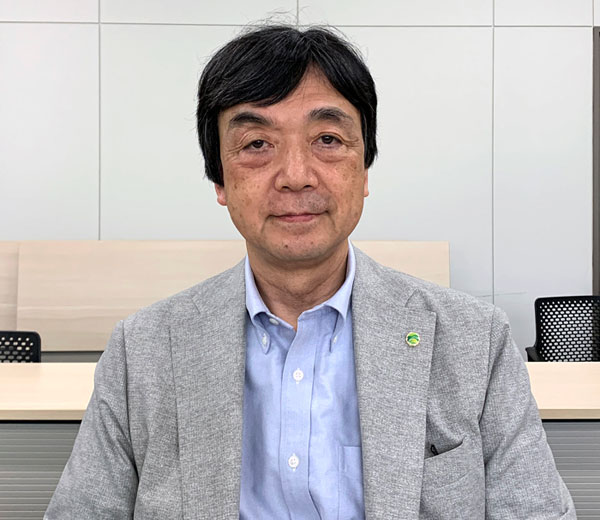
NARO, the National Agriculture and Food Research Organization, is responsible for research and development in Japan’s agriculture and food sectors. This April, its Sixth Medium- to Long-Term Plan, which sets out policy for the coming seven years, was launched, and Kazuhiro Chiba was newly appointed President.
President Chiba has held positions including President of Tokyo University of Agriculture and Technology. Drawing on his own experience as an entrepreneur, he places importance on the perspective of commercial viability when putting research results into practice in society. As the environment surrounding food and agriculture undergoes dramatic change, what challenges must NARO address? We asked President Chiba about the organization’s future initiatives.
◇ ◇
— Changes in the agricultural environment require an immediate response.
Chiba: First, there is the issue of climate change. In addition, population growth is creating a global food shortage. We will need 1.5 times as much agricultural production as we have now. Agriculture requires freshwater, but the situation could be described as a competition for freshwater. There is also a shortage of land, and we have reached the limit of creating farmland through deforestation.
In Japan in particular, the number of farmers in hilly and mountainous areas is declining. Japan’s food self-sufficiency rate is 38%, and 40% of that depends on hilly and mountainous areas. If the productive capacity of these areas declines, the food self-sufficiency rate will deteriorate as well. Food prices are expected to continue rising, potentially having a major impact on the structure of people’s consumption and, in turn, on Japan’s entire industrial structure.
— Abundant natural capital is a major strength for Japan.
Chiba: It may be possible to increase agricultural production by using large quantities of pesticides and chemical fertilizers, but this would lead to problems such as soil degradation and environmental pollution caused by dependence on fossil fuels. I call this a “negative externality.”
Japan’s abundant natural capital is a major strength in converting this into a positive externality. This may be described as coexistence with nature, but agricultural production activities can enhance natural capital. This is something that we must accomplish as the proper future form of agriculture, forestry, and fisheries.
— Supporting the construction of foundations for creating food value.
Chiba: The Sixth Medium- to Long-Term Plan sets out challenges including food security and improving food self-sufficiency capacity; the domestic and overseas deployment of technologies that have been developed; and the expansion of exports of agricultural products and foods, as well as the creation of new industries. However, as the reason NARO exists, I believe that “building the foundations of Japanese food” will be the most important priority in order to protect the health of the public.
We will make maximum use of the potential of natural capital to further strengthen the foundations of high-quality Japanese food. By applying cutting-edge technologies, we can create value such as improved food preservation and reduced food loss. These matters do not remain within the scope of agriculture alone. I want to support the construction of these foundations with the mindset of building a huge industry at the national level.
— NARO has a major role to play in industry-government-academia collaboration.
Chiba: Industry-government-academia collaboration is indispensable in putting research results into practice in society. However, Japan’s capacity to supply highly skilled personnel is only one-third that of other developed countries. What matters is not simply tripling the number of cutting-edge researchers, but increasing the number of leaders who can energize society.
Universities are also advancing cutting-edge research in the agricultural field, but in many cases they have not yet considered its commercial viability. We need people who can think about what will revitalize a region and how to do so, attract colleagues, and lead them.
NARO has demonstration sites throughout Japan. The infrastructure is in place to revitalize regions in cooperation with universities nationwide, from Hokkaido to Okinawa. I believe NARO can serve as a hub for industry-government-academia collaboration.