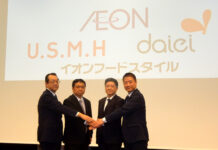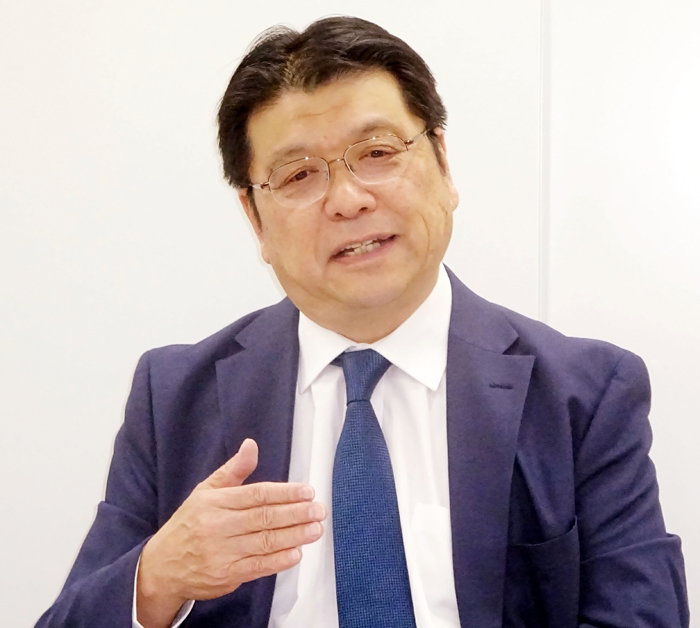
AEON Group is advancing a “regional shift” in its supermarket business. In the Kanto metropolitan area, the country’s largest consumer market, it aims to strengthen competitiveness around United Super Market Holdings (U.S.M.H.), which has sales exceeding 1 trillion yen. Under President Takemi Ide, who took office last May, the group is pushing ahead with the steady execution of its fourth medium-term management plan, while also creating group synergies and driving structural reform of the business.
◇ ◇
President Ide says, “Some analysts point out our low profitability. Recognizing that we are not fully leveraging the group’s scale merits and the strengths of each operating company, I held in-depth discussions with our management executives after becoming president as part of a ‘100-day reform.’ We will brush up the medium-term plan and refine our products and sales floors.”
In March, MaxValu Kanto, Daiei’s Kanto business, and AEON Market, all under the group, will integrate their management and launch a new company, Aeon Food Style. At the same time, the first store in the new “fresh deli expansion / price-strengthening” format will open, and all stores are scheduled to be renewed by fiscal 2030.
“Fresh deli products need deliciousness and freshness more than price. Price affects customer traffic, while strengthening fresh deli products affects visit frequency and customer spending per visit. Experimental stores have already produced considerable results, and we want to build a solid profit model with the new store format,” he said with emphasis.
On the supply infrastructure side for deli products, “process center (PC) reform” has become an urgent issue. At present, each operating company runs its own PCs separately. Rather than starting everything from scratch, the company intends to review the manufacturing functions, capacity, and equipment of each PC and optimize PCs in the Kanto area.
“While effectively utilizing existing group assets, we will strengthen new product development and reduce the workload in stores.” In addition, this spring a new “delica team” will be established within U.S.M.H. Along with introducing group co-developed products, raw materials for deli items such as rice and nori will be centralized. The aim is to reduce costs through scale merits and improve product quality.
Under the current consumer environment, responding to prices is unavoidable, but price competition without a built profit model can become a double-edged sword that may lead to even lower profitability. “Customers buy products based on value, but value (V) = quality (Q) ÷ price (P). It is important to balance quality and price by category and maximize value,” President Ide says.
National brand (NB) products have already shifted to common procurement and common billing arrangements. Going forward, the company will look toward standardizing shelf layouts. Companies within the AEON Group’s category management framework will also participate. “We are currently proceeding step by step, prioritizing items such as common shelf layouts and common promotions,” he says. Private brand (PB) products will be consolidated under U.S.M.H.’s “eatime,” and the Aeon Group PB “Topvalu” will also be expanded further.
President Ide emphasized, “Through synergies with the AEON Group, we will create funding through supply chain reform, invest it in process center reform, and provide better products to stores. We want to build such a profit model and create a virtuous cycle that enables sustainable investment.”