There are surprisingly few foods for toddlers that take the development of eating functions into account.
This point was made on July 31 by Yukie Yanagisawa, Professor Emerita at Wayo Women’s University. “From the ages of one to three, children do not yet have all 20 of their primary teeth, so eating is very difficult. Products that take eating functions into consideration are available for weaning foods, but this study made me strongly feel that it would be good if more snacks incorporating such considerations were developed for toddler foods as well,” she continued.
The study observed how approximately 30 children aged one to two eat snacks. It was conducted for the first time last June jointly by Kameda Seika, Calbee, and Wayo Women’s University.
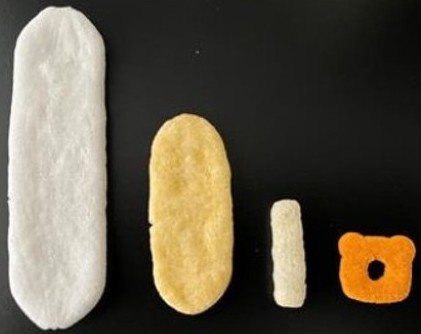
For an afternoon snack, the children were provided with one “Hai Hain” rice cracker from Kameda Seika, three prototype rice crackers from Kameda Seika, five pieces of “Sapporo Potato for Ages 1 and Up” from Calbee, and five “Vegeful Ring” pieces from Calbee. Professor Yanagisawa videotaped how the children ate them. No order of consumption was specified.
Analysis of the video footage found that toddlers adjust how they eat according to the shape of the snacks, and that they adjust both their number of chews and their eating method while sensing the snacks’ hardness.
Professor Yanagisawa focused on the fact that no behavior was observed in which multiple pieces were put into the mouth at once. “They put them in their mouths one at a time. There was not a single instance of two being put into the mouth simultaneously,” she said.
Akira Ito, Director of Kameda Seika’s Rice Research Institute, expressed confidence in the findings: “In this joint study, we observed how toddlers ate ‘Hai Hain’ and a rice cracker with a firmer bite. The results confirmed that all of the toddlers held the snacks in their hands and bit them off with their front teeth, and that differences in hardness affect the number of times they chew.”
Ryo Takei, Manager at the same institute, expressed the view: “The important point is that there are not many products focused on the step-up in hardness from infancy to toddlerhood. There are snacks that melt quickly, but there seem to be few foods that encourage chewing, and we believe snacks have significance in that area.”
In this respect, Calbee’s “Vegeful Ring” was developed with toddlers’ teething and jaw development in mind. Masae Nakano, Senior Executive Officer and CTO of Calbee, explained: “It was developed in response to requests from mothers who wanted something to help their children with teething. By chewing it thoroughly, children can benefit in terms of teething. We considered it a product with social significance.”
Katsuyuki Ishihara, General Manager of the Product Development Support Department, Research and Development Headquarters at Calbee, said of the study findings that insights had been obtained regarding size and hardness, adding, “The sample size has increased.”
This joint study forms part of a collaborative project between Kameda Seika and Calbee. The project brings together the two companies’ capabilities in product development, manufacturing technology, marketing, and sales and distribution know-how to solve broadly shared issues and create value, with a focus on product planning and development. Last year, the companies carried out a reciprocal collaboration between “Calbee Potato Chips” from Calbee and “Happy Turn” from Kameda Seika.