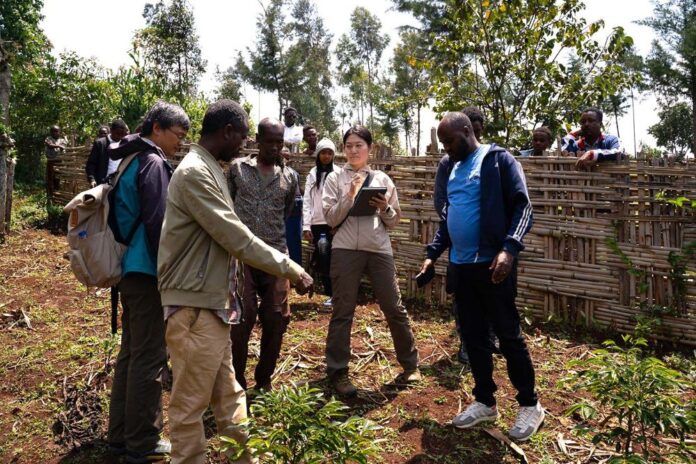
Key Coffee has been actively supporting small-scale coffee producers in recent years by leveraging its experience gained in the Toraja region of Sulawesi, Indonesia, where it operates a company-owned coffee estate.
The company also regards educational outreach and information sharing with Japanese consumers as a vital part of this support. In April 2022, it established the “Coffee for the Future Department” to promote deeper understanding of coffee origins and production through initiatives such as a dedicated product line named the “Coffee for the Future Series.”
In September, the fourth product in the series, “Ethiopia JARC74148”, was launched on Key Coffee’s official online store and at all directly managed retail outlets across Japan.
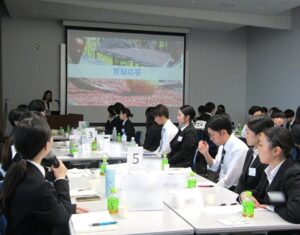
To coincide with the release, an open company seminar targeting university juniors was held on September 24–25 to promote both the product and the company’s sustainability initiatives.
The two-day program followed a schedule set by the Human Resource Development Department and took place at Tokyo Big Sight in Koto Ward, Tokyo, alongside “SCAJ World Specialty Coffee Conference and Exhibition 2025 (SCAJ2025).”
Students attended lectures covering coffee basics and Key Coffee’s business activities, toured the SCAJ exhibition, and participated in a lecture by the Coffee for the Future Department. Attendance totaled 35 participants on the 24th and 27 on the 25th.

On the 24th, the session was led by presenters and instructors Narie Fukunaga and Naoko Arinaga from Key Coffee’s Coffee for the Future Department.
In the lecture, the two reported on the Ministry of the Environment–commissioned project titled “FY 2024 Proposal for a Bright Future for Small-Scale Coffee Farmers Vulnerable to Climate Change”, integrating first-hand insights from their visit to Ethiopia.
They discussed how coffee from Ethiopia—regarded as the birthplace of coffee and the main source of the Mocha variety—is increasingly affected by climate change, threatening sustainable production. One major factor, they noted, is the shifting rainfall pattern.
Unusual rainfall during the dry season has caused coffee trees to flower out of season, leading to significant shifts in harvesting periods and major declines in yield due to disrupted growth cycles. The resulting off-season rains also promote mold growth after harvest, degrading quality considerably.
On the other hand, rising average temperatures have made coffee cultivation possible in highland areas that were once considered too cold, they added.
According to a brochure prepared by Key Coffee under the Ministry of the Environment project, bright future proposals for Ethiopian coffee include renewing and replanting coffee trees, and reforming drying techniques for coffee beans.
Regarding drying methods, Arinaga explained: “By using a hand pulper to remove the pulp before drying, producers can shorten the drying time of coffee beans and reduce the risk of mold.”
Arinaga visited Jimma, the largest city in southwestern Oromia, in September 2024 and conducted interviews with local cooperatives. Following her trip, in November of the same year, Hirokazu Fujii held a farming seminar with about 30 small-scale producers, proposing the introduction of wooden hand pulpers and replanting of coffee trees.

These new varieties are considered effective when combined with the planting of shade trees, irrigation, mulching, and cover crops. Jimma Agricultural Research Center (JARC) has in recent years emphasized the development and dissemination of drought-tolerant coffee varieties as key strategies for climate adaptation.
Ethiopia also faces challenges with coffee cherry diseases. As part of disease control efforts, JARC developed a variety designated “74148.” The fourth product in Key Coffee’s “Coffee for the Future Series” commercializes this variety and was also donated to JARC.

Fukunaga explained: “The ‘74’ in 74148 refers to the year 1974, when the parent coffee tree was collected before being officially registered as a variety. We hope this product helps people realize how coffee includes many different varieties and embodies great diversity.”
During the lecture, students sampled hand-dripped coffee brewed from the fourth product, providing a sensory entry point—using the experience of taste—to spark interest in the producing country.
Even after the completion of the Ministry of the Environment project, Key Coffee has continued its support activities for small-scale coffee producers.