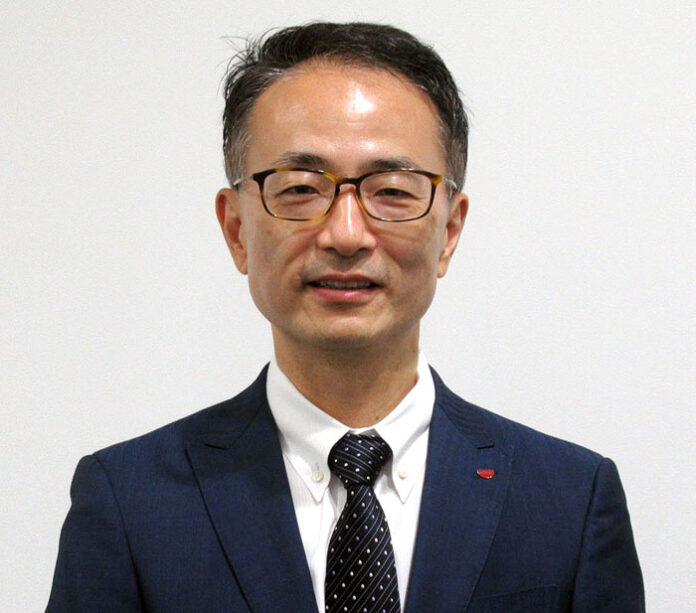
Masahiro Fukai, Managing Director and Head of Business Operations Division as well as General Manager of the Well-being Promotion Department, who is spearheading supply chain reform at Nissin Foods, spoke with conviction: “I recognize AI as an extremely important lever for improving logistics productivity. We are proceeding with the determination to rebuild our business processes from scratch, with AI utilization as a given.” He anticipates that AI adoption will advance significantly going forward, stating, “We are aiming to form new partnership frameworks with retailers and wholesalers in 2026 and achieve automated data integration with them.”
“People Are the Most Important Factor”
The company intends to leverage AI to thoroughly utilize POS data (product sales information) from supermarkets and other retailers, as well as manufacturers’ promotional data, in order to derive highly accurate demand forecasts. Discussions on collaboration with retailers and wholesalers are already underway.
For materials manufacturers, the company currently provides sales plans looking four months ahead and shares inventory status as well, building a system that enables planned and efficient procurement of materials.
Managing Director Fukai offered his outlook: “AI technology is evolving at a remarkable pace every day. For example, in the not-too-distant future, I believe it may become possible for the AI systems of our company, retailers, wholesalers, and materials manufacturers to match and optimize with one another.” He predicted the realization of a modern-day “CPFR” in which precise demand forecasts are shared across every stage of the supply chain.
He went on to emphasize that “people are still the most important factor.”
“Even when we talk about automation, machines don’t decide on their own to automate something. What is important is that business leaders and logistics personnel with intentions — like ourselves — along with everyone involved in the supply chain, identify and solve challenges on the ground. I believe that connects to the well-being of our employees and business partners as well. I want to paint an exciting vision for the future of this industry that attracts talented people. Ideally, reskilled management talent and DX talent will increasingly enter the world of supply chain in the years ahead.”
Toward Building a Physical Internet
Managing Director Fukai serves as a board member of the Physical Internet Center Japan (JPIC), which works closely with government ministries such as the Ministry of Economy, Trade and Industry (METI) and the Ministry of Land, Infrastructure, Transport and Tourism (MLIT). The initiative aims to apply the concept of internet communications to all areas of logistics through digital technology, with the goal of realizing a next-generation collaborative transportation and delivery system.
“Supply chains are social infrastructure. Reforming them is indeed difficult for any single company to achieve alone — collaboration among industry, government, and academia is indispensable,” he stated.
He revealed that government bodies, logistics stakeholders, and shippers actively participate in JPIC meetings and engage in vigorous discussion. “New business ventures are emerging from those discussions through novel combinations of players,” he noted.
In fiscal year 2026, the appointment of a “Chief Logistics Officer (CLO)” — responsible for overseeing logistics — will become mandatory for designated shippers with freight volumes above a certain threshold. “I’ve heard that the number of CLOs will grow to 3,200 next year, so I expect momentum toward realizing the Physical Internet will continue to build,” he said with anticipation.