Yoshimura, based in Shinagawa Ward, Tokyo, is a major manufacturer of packaging materials and packages for the tea industry. It was founded in 1932. It began as “Yoshimura Eiichi Shoten,” a business engaged in processing and selling ceremonial gift items, and entered the fields of paper-product packaging materials and bag making in 1948. In 1963, it built a factory and introduced offset printing presses.
Masao Yoshimura, the second-generation president who assumed the position in 1973, installed production equipment including gravure printing presses and expanded the business.
In 2005, current Chair Kumiko Hashimoto took over the company from her father, President Masao Yoshimura, becoming its third-generation president. She focused the company’s principal customers on the tea industry and introduced the “Esprit” plateless printing press in 2008, becoming the first in the world to successfully commercialize digital printing capable of handling small lots.
Particularly noteworthy was the company’s development of marketing aimed not at its direct customers—tea-manufacturing companies and tea specialty shops—but at end consumers. It developed products that expand tea-drinking occasions, including tea confectionery, the “Tokine” drip tea maker, a mini matcha shaker, and the “Leaf Tea Cup,” which contains tea leaves at the bottom. In 2022, it opened the “Chazakka” antenna shop in the Togoshi Ginza shopping street near its headquarters, creating a place to convey the appeal of Japanese tea directly to consumers.
As a result of also focusing on organizational reform that encourages employees to take ownership, the company has received numerous outside awards related to women’s advancement, diversity, and the promotion of telework.
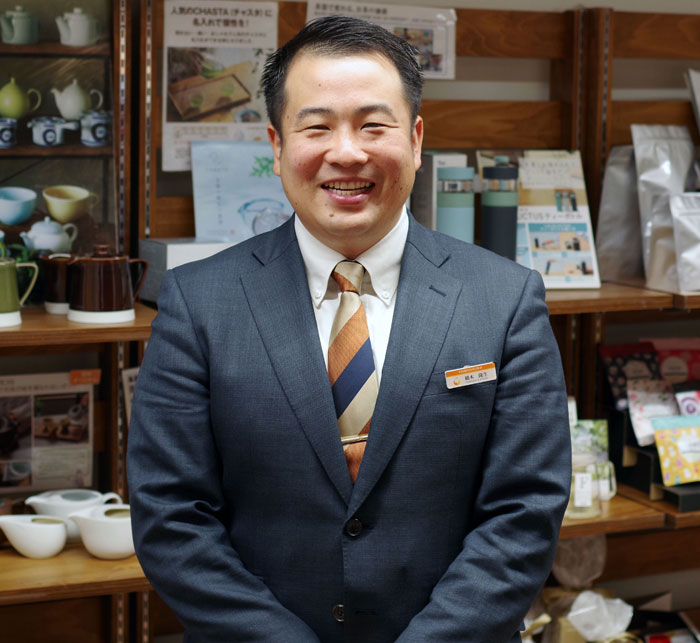
President Ryusei Hashimoto was born in 1990. He joined Yoshimura in 2017, at the age of 27.
His mother, Chair Kumiko Hashimoto, had never told him to take over the company. After graduating from university, he joined a food-related company because he was drawn to its business activities, which emphasized contributing to society.
However, the company’s management policy changed as soon as it was acquired by a major corporation, which made him feel uneasy. He came to feel that “I want to work for a company whose management philosophy and management policy are aligned.”
It was around that time that then-President Kumiko Hashimoto first asked him whether he intended to take over the company. This was because Yoshimura was formulating its 10-year vision.
After discussions with President Hashimoto, he decided to join the company. Having worked in production, sales, and planning promotion, he requested reassignment to the production division. In 2023, he became Head of the Production Headquarters. By making various decisions while bearing heavy responsibilities, he was able to dispel his anxiety about serving as president. In November 2025, he became the company’s fourth-generation president.
President Hashimoto cites three strengths of Yoshimura. The first is that it is a leading company in the niche field of “digital flexible packaging.” The second is its branding and planning capabilities as a platform provider for Japanese tea. The third is an organizational culture in which people act independently and proactively. Chair Hashimoto has made a major contribution to all three. Asked about this, President Hashimoto replied with a smile: “The previous president built the foundation for growth. If the company were to falter under my leadership, it would be 100% my responsibility.”
However, domestic demand for tea is not continuing to rise. President Hashimoto believes that “what Japan needs in order to shine in a way that is uniquely Japanese is tourism and exports,” and he is looking overseas. Since fermented teas such as black tea account for the majority worldwide, he identifies the challenge as follows: “It is important to determine how to position Japanese tea, which is an unfermented tea, in the market.”
He is also looking beyond exports. He is currently involved in a regional revitalization project in Yaizu City and is considering ways to convey Japanese tea culture in combination with tourism. “I want to create a future in which tea is drunk more,” he said.
When he traveled around Japan by bicycle as a student, he found appeal in every place he visited. Japan has “resources” that should be protected beyond tea as well. President Hashimoto expressed his far-reaching ambition: “When considering the rebranding of Japan’s resources, I want us to become a company people can rely on.”