Nissui will expand harvest volumes from its domestic salmon aquaculture business to more than double the fiscal 2025 level, reaching a scale of 10,000 tonnes by fiscal 2030. Three fishing grounds in Iwate Prefecture will drive this growth.
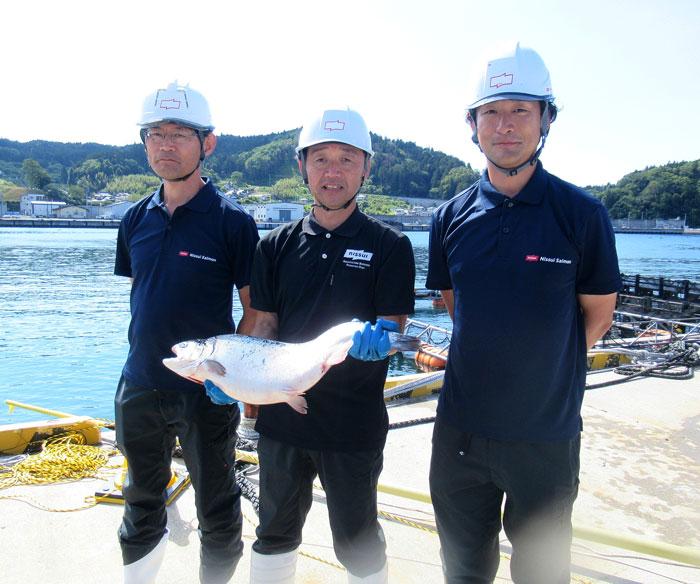
A reporter recently visited the production site along the coast of Hirota Bay in Rikuzentakata. The operation already has an integrated series of processes, from the rearing of juvenile fish through harvesting and processing. By next year, however, it will introduce a state-of-the-art feeding barge and five fish pens measuring 50 meters in diameter. Through traditional katsujime processing—killing fish while still alive—with a focus on freshness, the company will deliver high-quality salmon to dining tables more widely.
According to Hiroshi Tsuruoka, President of Nissui Salmon Co., Ltd.—a group company renamed from Yumigahama Suisan effective April 1—salmon and trout have remained comparatively firm in Japan, even as domestic consumption of seafood declines. In recent years, however, catches of autumn salmon along the Sanriku coast have fallen sharply. Farmed salmon, on the other hand, is on an upward trend. He explained that “farmed salmon is believed to have accounted for more than half of the domestic supply in 2025.”
The company’s domestic salmon aquaculture business operates at five locations: Sakaiminato in Tottori Prefecture; Sado in Niigata Prefecture; and three locations in Iwate Prefecture—Otsuchi, Ofunato, and Rikuzentakata. Of the 10,000-tonne target for 2030, the company plans to raise output in Iwate Prefecture to 7,000 tonnes, from 1,478 tonnes in 2025.
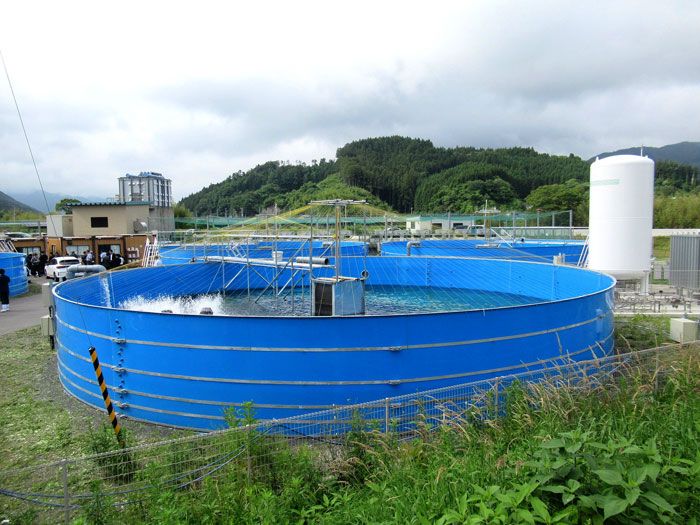
To achieve this, it is expanding its facilities in stages. Last October, the Kesen River Fish Farm, a juvenile-fish facility for salmon aquaculture, began operating in Rikuzentakata. The facility has 10 tanks, each with a water capacity of 300 tonnes and a diameter of 15 meters. From April through November, juvenile fish are raised from 5 grams to 200 grams and then transferred to marine fish pens. Their average weight at harvest is expected to grow 13-fold, to approximately 2.6 kilograms. Stocking density is set at 3% per tank. The 10 tanks, with a combined capacity of 3,000 tonnes, will raise 90 tonnes of juvenile fish annually, equivalent to an anticipated harvest volume of 1,300 tonnes.
The Kesen River Fish Farm was developed by renovating part of the Hirota Bay Fisheries Cooperative’s autumn salmon hatchery. A key point is that it shares the area’s abundant groundwater. There are approximately 40 similar hatcheries in Iwate Prefecture, but their operating rates have declined due to the substantial fall in autumn salmon catches. With the understanding of local communities, Nissui Salmon plans to repurpose these facilities as juvenile-production sites for coho salmon. The company stated: “In the near future, we aim to add several new fish farms and expand to a structure capable of harvesting 2,000 to 3,000 tonnes using our own juvenile fish.”
Pursuing Freshness Through Katsujime
The company has conducted marine aquaculture at the Takihama fishing ground in Hirota Bay since 2024. This season, it used two 25-meter-diameter fish pens, with a harvest volume of approximately 300 tonnes.
However, with prospects for commercialization now in place, it will significantly expand to five 50-meter-diameter fish pens by next year. It aims for harvest volumes on the order of 2,000 tonnes at the site. It will also introduce a state-of-the-art feeding barge this autumn.
“We will combine aquaculture technologies cultivated in Sakaiminato with new technologies to further improve productivity and quality,” President Tsuruoka said.
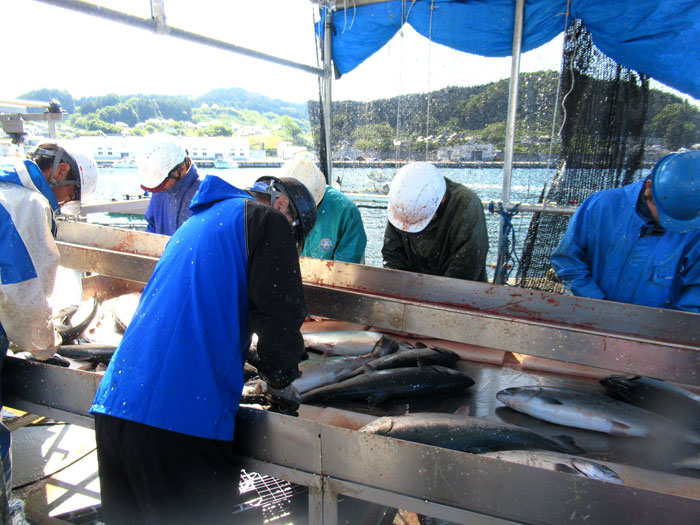
Coho salmon are harvested in Hirota Bay from May through June. They are lifted from shipping pens at the quay using a net attached to an excavator.
The fish are then immediately moved to the katsujime process. They undergo electrical treatment on an electrical calming table, after which each fish, once calmed, is swiftly processed individually using katsujime.