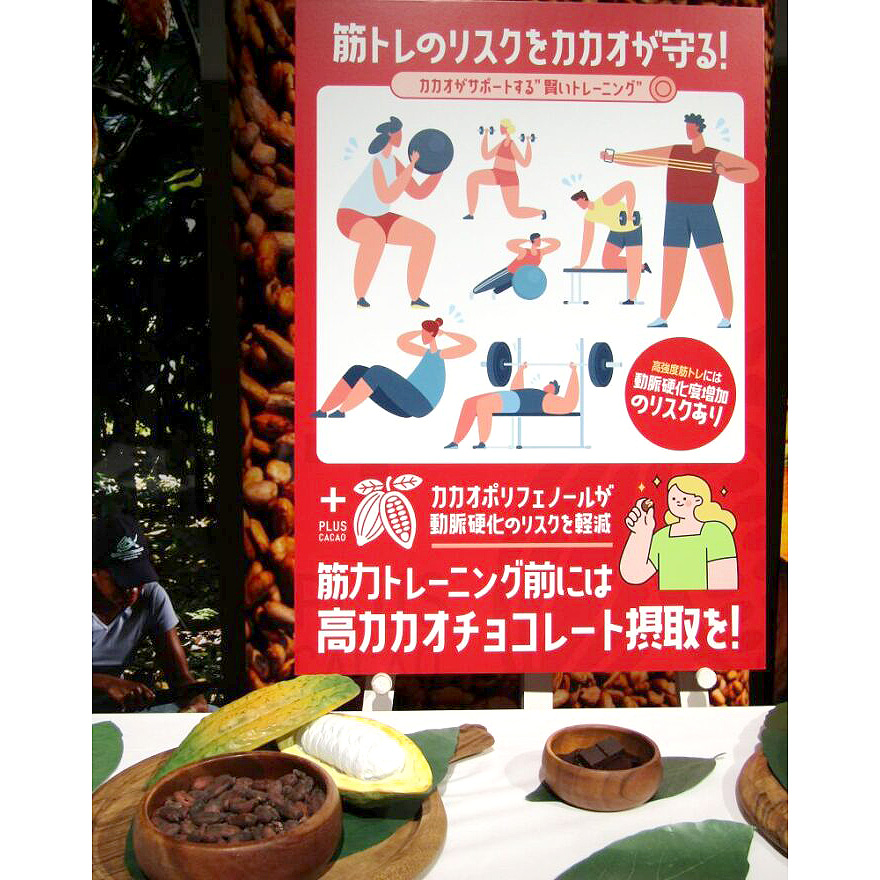
A research group from Meiji and Nippon Sport Science University has found that consuming high-cacao chocolate before high-intensity resistance exercise (strength training) leads to a rapid reduction in the exercise-induced increase in arterial stiffness.
At an event held on November 27, Hidekazu Hagiwara, Executive Officer and Head of the Global Cacao Business Division at Meiji, stated: “While strength training is highly effective for maintaining good health, it also temporarily places a burden on blood vessels. This research suggests that consuming high-cacao chocolate may help reduce that vascular burden before strength training. We consider this a noteworthy finding in supporting everyday health promotion and exercise habits.”
He also touched on recent research demonstrating that cacao polyphenols found in cacao deliver a range of health benefits, including improved blood flow and antioxidant effects.
In this study, researchers compared changes in arterial stiffness exhibited by healthy young men after high-intensity resistance exercise when they consumed high-cacao chocolate containing cacao polyphenols versus white chocolate containing none.

Twelve healthy young men (average age 23) participated, consuming either 50g of high-cacao chocolate (1,285mg of cacao polyphenols) or 50g of white chocolate on separate randomized days.
After consuming each type of chocolate, all participants performed bench press (5 reps × 5 sets at 80% of one-repetition maximum) and arm curl (10 reps × 5 sets at 70% of one-repetition maximum) exercises.
To measure arterial stiffness at five time points — before eating the chocolate (baseline), 60 minutes after consumption (pre-exercise), immediately after exercise, and 30 and 60 minutes post-exercise — researchers measured the brachial-ankle pulse wave velocity (baPWV), an indicator of exercise-induced increases in arterial stiffness, along with arterial compliance and the β-stiffness index. Results confirmed a rapid reduction in baPWV.
On the other hand, no significant changes were observed in arterial compliance or β-stiffness, leading researchers to conclude that the effects of consuming high-cacao chocolate appear primarily in the peripheral arteries and did not affect the central arteries.