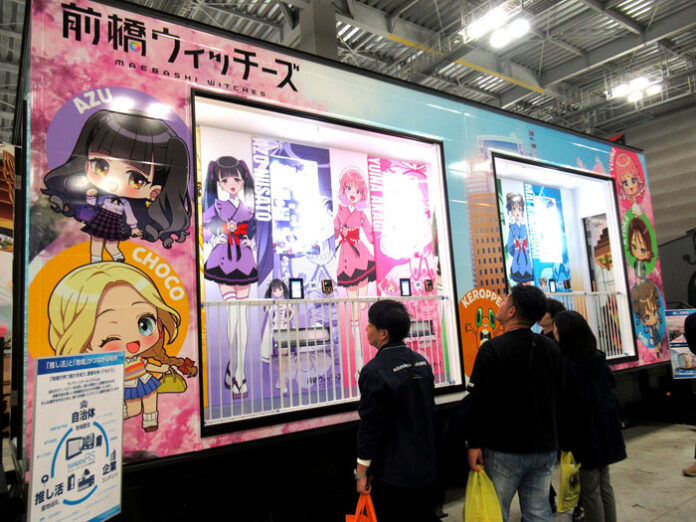
Sanden Retail Systems, a developer of beverage and food vending machines, recently unveiled a prototype of its “Oshikatsu Retail Trailer House,” designed to make “oshikatsu” (fan support activities) more comfortable and enjoyable. Jointly developed with Trailer House Development, the first unit features a full decorative wrap inspired by the world of “Maebashi Witches,” an anime set in Maebashi City. The initiative is expected to resolve long waiting lines, which remain the biggest challenge in event merchandise sales.
The unit was exhibited at the “Tokyo Trailer House Show” held at Tokyo Big Sight from November 26 to 28. As this is a prototype, the specific timing for commercialization and service launch will be determined based on market response.
The new trailer house is equipped with five merchandise vending machines. It is capable of traveling on highways, allowing it to be deployed quickly to event venues across the country. Its high-impact design is also expected to serve as a photo spot for fans.
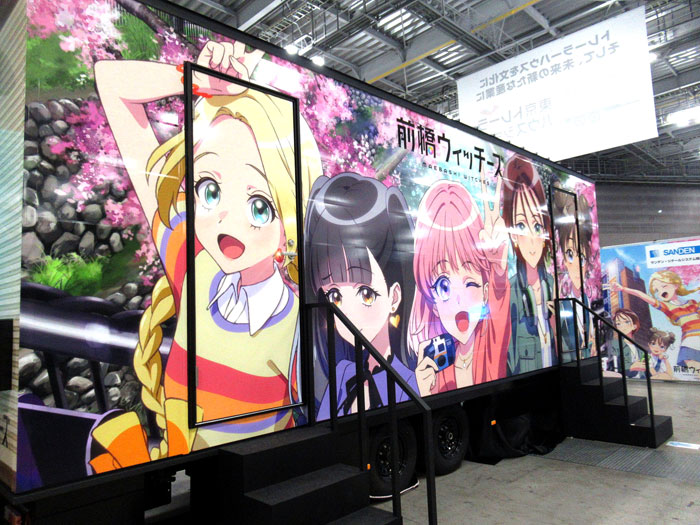
The system utilizes a completely cashless payment method. By eliminating manual order verification, cash transactions, and the handling of change, the solution achieves labor savings and is expected to eliminate long queues. By adopting a proprietary dispensing mechanism, the machines can handle a wide range of merchandise sizes, including cards, button badges, acrylic stands, towels, and T-shirts. Restocking can be managed by a small team from the rear of the trailer house.
As part of a promotion for Maebashi City, Gunma Prefecture—where the company’s primary production base is located—this prototype was created in collaboration with Maebashi City and the Bandai Namco Filmworks anime “Maebashi Witches.” Looking ahead, the company stated, “We will propose this as a new retail solution for various ‘oshikatsu’ users, event organizers, IP holders, and local governments.”