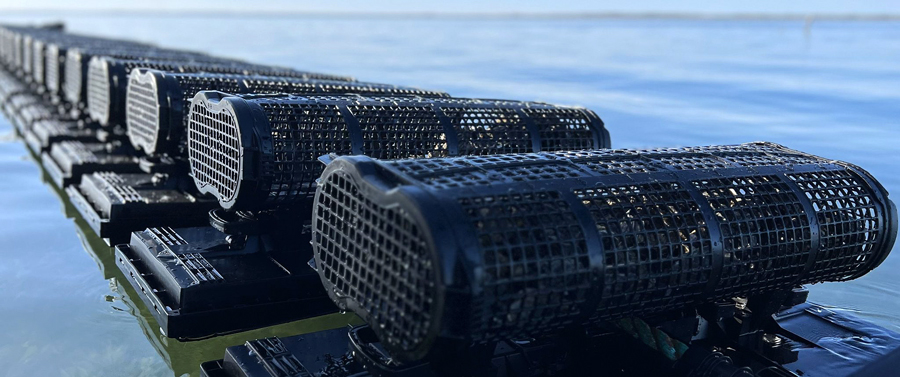
Oyster farming in the Seto Inland Sea has suffered severe damage, affecting not only the fresh seafood market but also processors and distribution. Amid this situation, the single-seed farming method, which differs from conventional farming methods, is drawing attention. Its strength lies in the ability to efficiently produce in-shell oysters, a market that is expanding. SEAPA Japan (Osaka) supplies the materials needed for this method and is also focusing not only on oyster farming but on new businesses related to aquaculture in general, including cultivation equipment. We asked President Takehiro Yoshimoto about the current state of the industry and its outlook.

——Oyster farming in the Seto Inland Sea has suffered severe damage. In that context, please tell us why single-seed farming is spreading.
Yoshimoto: Regarding this mass mortality, I understand that producers and related parties are responding seriously, but a direct solution has not yet been found. If the marine environment continues to change, it will be necessary to artificially produce seed that can adapt to the environment, and in addition to conventional natural spat collection, the proportion of artificial seed will need to be increased.
Australia’s industry organizations have knowledge and experience in the technology of raising seed that has resistance to factors that cause adverse effects, and at our request they have shown a willingness to cooperate in solving Japan’s issues.
Not only is the marine environment changing and production becoming unstable, but labor shortages such as a lack of successors and the problem of unstable prices have also been pointed out.
Meanwhile, “in-shell oysters” are being sought mainly by the restaurant industry and overseas markets. However, with conventional farming methods, there are limits in terms of efficiency when producing in-shell oysters. Producers who feel a sense of crisis over these challenges want to efficiently produce high-quality in-shell oysters, and single-seed farming is meeting that demand.
——What factors are driving the growth of in-shell oysters?
Yoshimoto: It originally began with restaurants such as oyster bars, and now more retail stores are also selling them in-shell. While there is a preference for thrift, demand is also growing for high-quality foods and products with a strong emphasis on origin.
In-shell oysters make it easier to promote the characteristics of the production area, and because they are distributed alive, they are also fresher. At oyster bars, it is often possible to compare oysters from different production areas side by side, and the producer’s name or brand is often displayed. In-shell oysters have high added value and are easier to differentiate. Although still limited to some department stores and the like, we hope that in the future people will enjoy in-shell oysters at home the same way they buy asari clams.
For producers as well, if there is no need for shucking labor and they can be sold at a high price, it makes sense to produce in-shell oysters. (to be continued)