——What is the outlook for single-seed oyster farming?
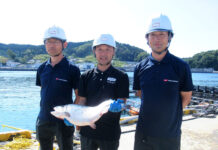
Yoshimoto: Single-seed farming is spreading as a way to efficiently produce high-quality in-shell oysters. At the “Oyster-1 Grand Prix,” organized by the National Oyster Council, producers working on this method occupy the top positions, and the term “single-seed” has become familiar not only to oyster fans but also to ordinary consumers.
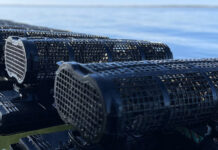
Sales of the baskets, the core technology behind our single-seed oyster farming, are growing significantly every year. As mentioned earlier, the need for artificial seed will only become stronger in the future, and at the same time, the single-seed method is expected to become more common as a suitable farming method.
——In the previous fiscal year (fiscal year ended June 2025), sales roughly doubled. What were the reasons?
Yoshimoto: One reason is that single-seed farming has begun to spread in earnest. Awareness among producers has widened, and production volumes have increased. Another is that the number of installations of our microalgae bioreactors has increased. Both our existing businesses and new businesses grew substantially. We are planning sales 1.5 times higher this fiscal year as well.
——What kind of equipment is the new business, the microalgae cultivation system?
Yoshimoto: Microalgae are the foundation of the aquaculture food chain, and they are direct feed for larvae, juvenile shellfish, juvenile shrimp, juvenile sea urchins, and so on.
However, conventional cultivation methods are labor-intensive and unstable. Because they are cultivated in open tanks, bacteria and other contaminants can enter and cause collapse, so even when labor is devoted, the risk of failure is high.
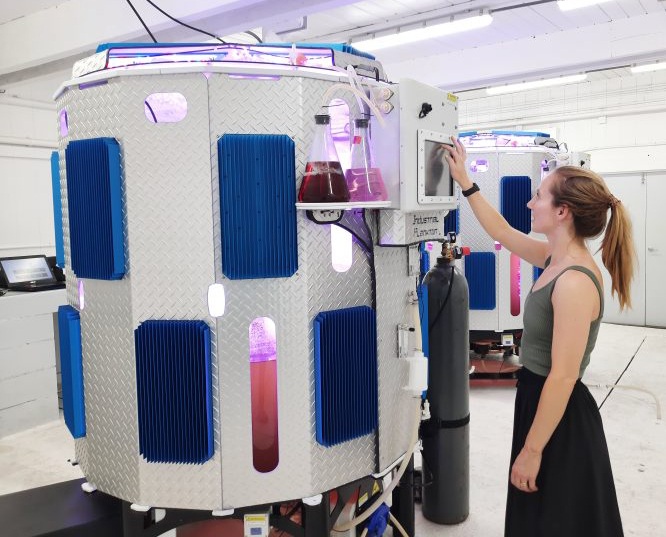
The Canadian-made system we sell automates and stabilizes cultivation. One unit can cover production equivalent to fifteen 5-ton tanks, so both labor and floor space can be reduced dramatically. Running costs are also limited to about the same as the electricity bill for home use.
For seedling producers, the cost of cultivating microalgae accounts for 40% of the total. Since seedling output is determined in proportion to microalgae production volume, solving this issue can raise the capacity of seedling production.
It is also used as an ingredient in supplements and cosmetics, so its applications are broad. Looking ahead, major manufacturers are also showing interest in using it as aircraft fuel.
——What other new businesses are there?
Yoshimoto: We acquired the master agency rights for a purification system manufactured by the French company EMYG Aqua. Using technology centered on fine bubbles, it removes E. coli and other contaminants from oysters and improves safety, and it is used by major producers around the world such as Taylor (U.S.) and Gerardo (France).
Many oyster purification methods in Japan are simple, using flow-through water or UV, and now that exports to overseas markets with high safety standards are increasing, we believe there is demand for methods that can better emphasize safety.
It also has the “storage” function that is common in Europe and the United States. While controlling water quality and water temperature, it maintains oysters in a good condition after purification, allowing producers to choose when to ship them. It also handles natural disasters such as typhoons and red tides, making it possible to adjust shipments according to customer requests.
Going forward, we want to continue introducing systems that have a track record overseas and improve quality and efficiency to Japan, and contribute to the evolution of the aquaculture industry.
(The end)