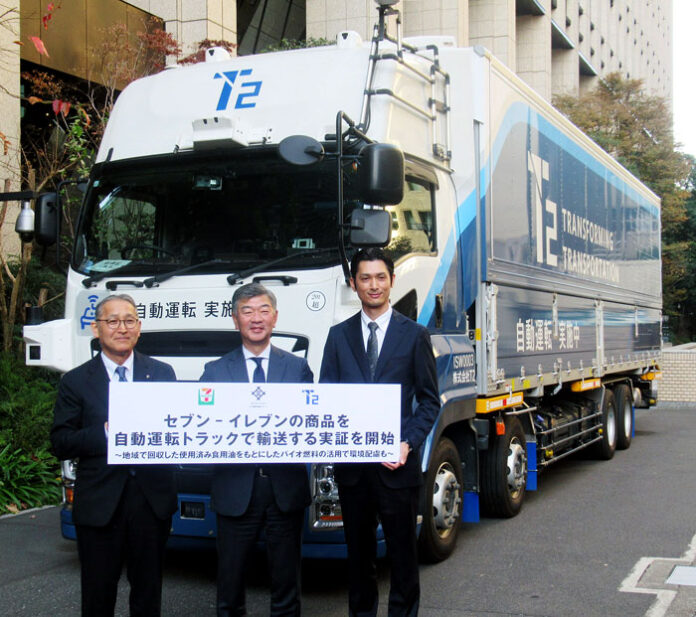
From this month through April, the companies plan to conduct three demonstration tests. Using a Level 2 autonomous truck (10-ton vehicle) employed in T2’s commercial operations that began in July this year, they will transport Seven Premium ambient products—cup miso soup, umbrellas, kitchen paper, and soft tissues—from MRG’s Saitama No.2 Center (Niiza City, Saitama Prefecture) to its Kansai Center (Amagasaki City, Hyogo Prefecture).
The Level 2 autonomous driving section covers approximately 450 kilometers, from the Tomei Expressway’s Ayase Smart Interchange to the Meishin Expressway’s Amagasaki Interchange. The tests will verify the feasibility of long-distance highway driving by autonomous truck, the stability of cargo transport, and the effectiveness of required transport time and operational procedures.
In addition, the demonstration tests will expand Seven-Eleven Japan’s “circular economy” initiative, under which biofuel made from used cooking oil collected locally is being test-introduced into store delivery vehicles, and will use it for the first time as fuel for an autonomous truck. Through this, the companies will examine whether it is possible to build a sustainable logistics system from both the standpoints of addressing labor shortages and environmental consideration.
At a joint press conference on the 1st, T2 President Masatomo Kumabe said, “At a time when driver shortages have become a social issue, securing long-distance transport capacity is an urgent challenge. Our company will move ahead with realizing trunk-line transport services using Level 4 autonomous trucks in fiscal 2027 and building transfer hubs in the Kanto and Kansai regions.”
Kosuke Shibata, President of MRG, expressed his expectations, saying, “Following the demonstration tests, we would also like to consider participating in the commercial operations and trunk-line transport services carried out by T2.”
Shigeru Yamaguchi, Executive Officer and Head of QC and Logistics Management Division at SEJ, said, “Securing transport capacity for the future has become an urgent task, and we will move forward with building a sustainable logistics system from both standpoints of addressing labor shortages and environmental consideration.”