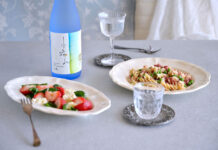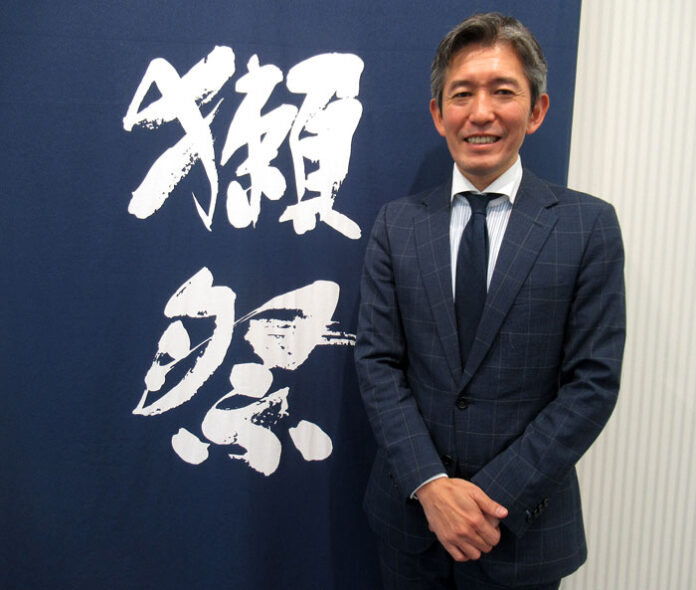
Exports of the sake brand “Dassai” are growing in countries around the world. In the previous fiscal year ending in September, of total sales of 21.3 billion yen (up 9 percent year on year), export results (excluding untaxed shipments) came to 7.9 billion yen, a full 40 percent increase. Although the restaurant markets in both China and the United States, the leading destinations, have stagnated due to the effects of economic slowdown and inflation, Kazuhiro Sakurai, president of Dassai, said, “Being a top sake brand overseas has become our strength. Precisely because the market environment is cautious, customers chose us for our sense of trust and stability.”
Growth in China, the U.S., and Other Markets
In the previous fiscal year, total company-wide shipment volume was 6,860 kiloliters (about 38,000 koku), of which exports accounted for 3,193 kiloliters (about 17,700 koku).
Regarding export trends, President Sakurai said that “there are differences depending on the country and region,” but he nevertheless gave a positive assessment, saying, “Even under a difficult market environment, we were able to grow in our major destination countries.”
In China, where shipment volume is large, the brand has maintained solid demand even while consumption overall remains sluggish. In that country, it is common for customers to bring alcoholic beverages into restaurants, but recently there has been an increase in cases where restaurants place orders directly through e-commerce. He said that, in addition to relatively affordable prices, the convenience of short delivery times has also become established. “It is definitely spreading as a new sales channel,” President Sakurai said.
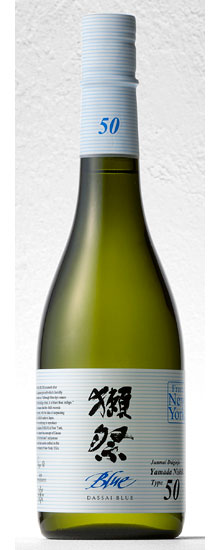
Exports to the United States also exceeded the previous year, despite being affected by inflation and Trump tariffs. In the U.S., the company is also developing “DASSAI BLUE,” produced at its American brewery in the suburbs of New York. In its second year after launch, the previous fiscal year posted double-digit growth, reaching about 750 koku. In its third year, the company has set its sights on surpassing 1,000 koku.
The lineup includes “Type 23,” positioned as the flagship as in Japan, polished to 23 percent; “Type 35,” brewed with 100 percent Yamada Nishiki rice from Arkansas; and “Type 50,” in a relatively accessible price range.
As a new development, inquiries from local liquor stores have increased. President Sakurai said, “We believe this reflects improved price competitiveness compared with imported products, as well as the effects of inflation.”
Regarding the relationship with Japan-made “Dassai,” he said, “Both are basically sold through the same distributors. Rather than forcing a division between them, there are many cases where both are handled by the same restaurants, regardless of whether they serve Japanese or Western cuisine.”
Opportunities in Overseas Duty-Free Shops
More recently, the company has also been focusing on developing overseas duty-free shops. In Taiwan, the products have been sold for some time and have grown to a reasonable scale, and in South Korea, where sales started last year, the initial response has also been favorable.
President Sakurai said, “Selling sake requires investment in refrigerated management, but ‘Dassai’ is recognized as a strong brand in Japan’s airport duty-free shops, and successful cases have also emerged in Taiwan and South Korea. We see growth potential in overseas duty-free shops, and first we want to deepen our efforts mainly in Asia, where our brand is already beginning to take hold.”
Looking toward 2026, the overall export sales plan includes measures to shore up countries and regions where growth lagged in the previous fiscal year.
President Sakurai said, “Australia, Canada, and Taiwan have grown steadily so far, but in some respects we have relied on the strength of the ‘Dassai’ brand. Our efforts to dig deeper into demand ourselves were not sufficient. After all, it is important to carefully communicate Dassai’s sake brewing and the dedication behind it. If local distributors lack sufficient manpower, we would also like to consider hiring local staff ourselves.”