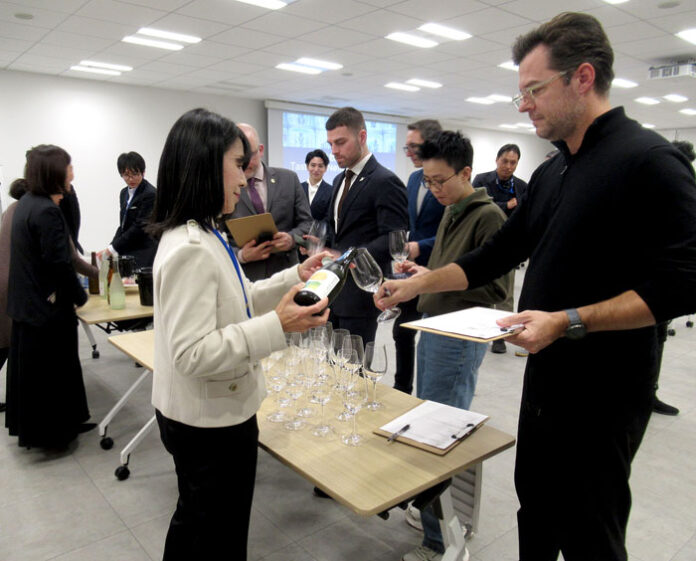
With the cooperation of its partners, including the Union de la Sommellerie Française and the Association de la Sommellerie Internationale, the Japan Sake and Shochu Makers Association recently invited to Japan five top sommeliers from around the world—one from Asia, three from Europe, and one from South America—who are representatives of sommelier associations or winners and recipients of major competitions. On November 22, they held a talk session under the theme “Sake as Seen from the World,” where they discussed market trends in their respective countries and future possibilities.
The five sommeliers all serve sake at high-end restaurants overseas. Louis Le Conte of France emphasized that he “sees potential in pairing cheese with sake.” In particular, he said that “creamy cheeses such as Camembert and Brie pair exceptionally well with sake such as junmai daiginjo.”
As another recommendation, he introduced the fact that sake also goes well with desserts. “If wine becomes too dry, sake with a sense of sweetness is better suited. For example, with mille-feuille, I would confidently recommend pairing it with nigori sake,” he said.
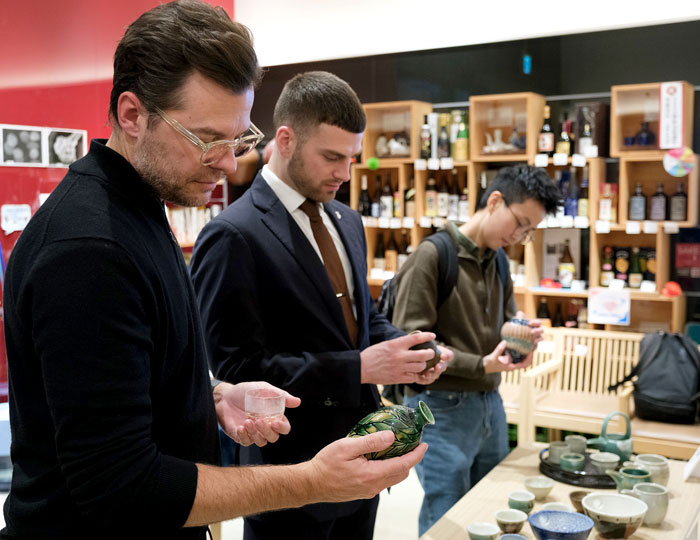
Prior to the talk session, the five top sommeliers visited sake breweries in Miyagi and Akita prefectures, as well as facilities related to Japanese culture and fermentation technology, from November 17 to 21. Through these multifaceted experiences, they explored in depth the appeal and potential of sake.
Andrew Truong of Vietnam commented, “What impressed me about Japanese sake breweries was how traditional techniques and ways of thinking coexist with modern equipment and approaches. The sake market in Vietnam is still new, so if good information and products are delivered, the future of the market is bright.”
Gabriel Lucas of Spain said, “Sake is gradually spreading in fine dining and high-end restaurants in Europe. However, the premium segment, such as junmai daiginjo, is leading the way, and personally I would like to broaden it so that more casual consumers can pick it up in the future. I think there is an opportunity in the fact that it has lower alcohol than distilled spirits and in appealing to people who usually drink wine.”
Julio Cesar Kunz of Brazil said, “The market for premium alcoholic beverages is growing in Brazil. I think sake is the craft beverage that will come after wine. Brazil has a Japanese immigrant community and many Japanese restaurants, but more action is needed so that people can better understand sake. I believe it can enhance its presence by making use of its unique individuality.”