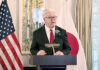
On May 29, the U.S. Dairy Export Council (USDEC) held a media roundtable in Tokyo. Executives visiting Japan, including Chair Becky Nyman, positioned the Japanese market as an important export destination and expressed their willingness to expand supplies, particularly of cheese and dairy-protein ingredients.
Executive Vice President Allison Thomas referred to the fact that U.S. agricultural exports to Japan exceed $12 billion, with dairy products making Japan the United States’ third-largest export market, ahead of China. She said: “U.S. dairy products have become well established in the Japanese market, and we can continue to contribute in areas where they are needed.” She said the group had particularly recognized strong interest in cream cheese and butter by product category, expressing its intention to “develop a framework that can meet Japanese demand.”
Regarding whey protein, for which demand is expanding globally, Chair Nyman explained: “Supply is tight, but the United States has ample capacity to increase production.” Against the backdrop of growing demand for sports nutrition and health-oriented products, investments in production facilities and increased production of high-value-added products, such as WPC (whey protein concentrate) and WPI (whey protein isolate), are progressing. “Whey was once a by-product of cheese, but demand has risen to the point that cheese is now said to be a by-product of whey,” she said.
Construction of new cheese plants is also continuing. Regarding the target announced in 2022 of increasing cheese production by 500,000 tonnes by 2027, Nyman said, “We expect to achieve it ahead of schedule,” expressing confidence in stable supplies to export destinations including the Japanese market.
Vice Chair Mike Marley, reflecting on discussions with Japanese dairy-industry stakeholders, said: “The challenges faced by dairy farmers in Japan and the United States—including economic, environmental, and successor-related issues—are common to both countries. I came to recognize a path toward coexistence, in which U.S. products supplement areas where Japan faces shortages.”