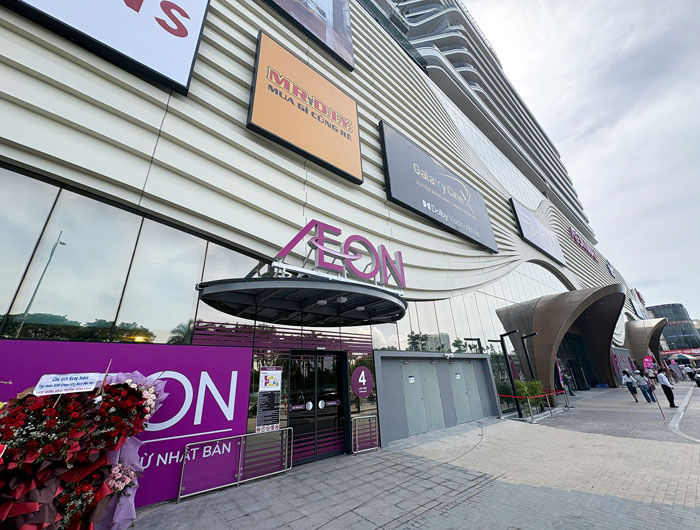
AEON aims to achieve ¥300 billion in operating revenue from its Vietnam business in fiscal 2030. Its business has recently expanded to the ¥100 billion scale, 2.5 times its pre-pandemic level. The company expects average annual growth of 25% over the next five years as well. It will accelerate market development through a multi-format strategy combining large stores with small and medium-sized stores.
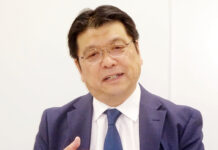
At an online briefing held on July 8, AEON Vietnam President Daisuke Tezuka and COO Takushi Oizumi discussed the state of the business and its policies.
At present, the company operates eight shopping centers, 15 large-format supermarkets including GMS stores, 36 supermarkets modeled on Japan’s “My Basket” format, 182 convenience stores, 74 specialty-store and service outlets, and one Tsuruha drugstore in Vietnam.
Under the five-year plan beginning in fiscal 2026, the company will put into action the “acceleration of new store openings.” It will open the most suitable formats in three types of areas: urban areas, regional core cities, and suburbs.
In the first year, it will accelerate its pace of store openings compared with the past by opening four shopping centers, which have a large revenue scale, and one large-format store.
Expanding the supermarket-format “MaxValu” in the country’s two major metropolitan areas is also a key theme. The format has taken the lead in Hanoi in the north and has reached profitability, while the company is also accelerating its rollout in Ho Chi Minh City in the south. The plan is to establish a 300-store network by fiscal 2030.
The company will also promote the “strengthening of the product supply chain.” Private brands, including “Topvalu,” currently account for approximately 6% of sales, but the company will raise this to 20%—the same level as in Japan—over the coming five years. Rather than relying on imports from Japan, it intends to establish private-brand products as locally made “Made in Vietnam” and “Made in ASEAN” offerings that provide both quality and value for money.
To support the accelerated pace of new store openings, the company will strengthen central-kitchen functions in addition to logistics centers. Following its bakery operations in northern Vietnam, it also plans to open a bakery in the south.
Regarding Vietnam’s market environment, the company stated: “In urban areas such as Ho Chi Minh City and Hanoi, consumer income levels are rising and demand for high-quality food is increasing. However, modern retail formats such as shopping centers and supermarkets account for only around 15% nationwide. Many regions have not yet modernized, and we recognize that it is important to meet both sets of needs. In any case, it is highly likely that the proportion of modern retail will rise as the economy develops.”