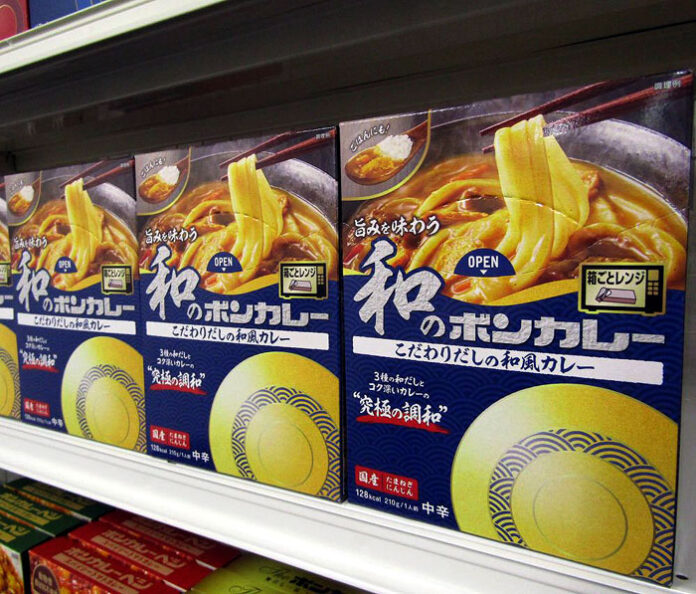
Otsuka Foods, under its “Bon Curry” brand, is focusing on the new product released on September 1, “Japanese-Style Bon Curry for Enjoying Umami: Japanese-Style Curry with Carefully Selected Dashi” (“Japanese-Style Bon Curry”). The company will propose the product not only for the retort curry section but also for noodle sections and other areas, thereby expanding its category footprint.
The product is made as a Japanese-style Bon Curry that can be enjoyed with both noodles and rice, harmonizing a rich, full-bodied curry with three types of Japanese dashi—katsuobushi (bonito flakes), kombu (kelp), and niboshi (dried sardines).
It was developed based on the view that, while rice consumption is stagnating, the noodle market and Japanese-style products are trending toward expansion.
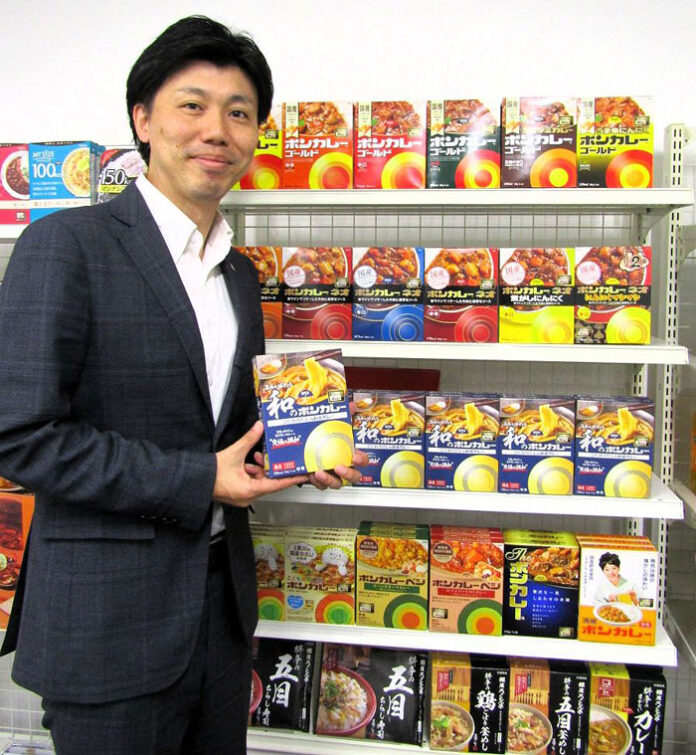
Regarding the development, Shintaro Morikawa, Product Department Retort Team Leader, who responded to an interview on October 23, recalled: “As demand for noodles has been increasing, we thought we didn’t have to be bound by the conventional wisdom that ‘retort curry is something you pour over rice,’ and that it would be fine to have retort curry that you pour over noodles and eat.”
As a product for noodles, the company launched in March last year “Bon Curry: Curry Udon Base for Enjoying Umami,” intended exclusively for curry udon. This time, “Japanese-Style Bon Curry,” launched as a replacement for that product, puts a Japanese-style profile front and center, and will be promoted as a new retort curry that can be enjoyed with both noodles and rice, rather than being limited to udon only.
The company focused on the expansion of the Japanese-style product market and on the growing number of products and foodservice menus that use dashi as a key theme. The main target is women in their 40s to 60s who like “Japanese-style curry.”
“We communicate on social media and continue proposing various new ways to eat curry. Also, because Japanese and Japanese-style products are well liked by people from overseas, we will also keep measures to capture inbound demand in view going forward,” Morikawa said, showing enthusiasm.