Over the past decade or so, the packaged rice market has achieved remarkable growth. Backed by changes in household composition and lifestyles, as well as heightened stockpiling awareness, it had continued on a steady upward trajectory, but rising retail prices caused by the surge in rice prices since last year are now putting the brakes on demand growth.
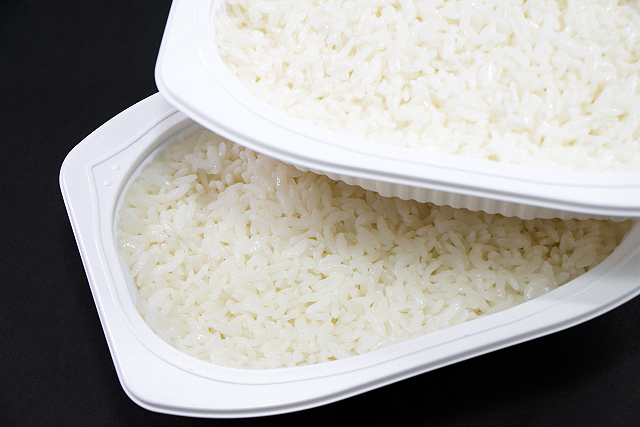
A key feature of packaged rice is its convenience: it can be heated in a microwave for just two minutes and enjoyed with the taste of freshly cooked rice. As single-person and small households have become more common, it has also gained support for offering better time performance than cooking rice for each meal.
Its value was reassessed through repeated natural disasters and then the COVID-19 pandemic, and it has become established not only as an emergency stockpile food but also as an everyday staple. Compared with the period before the Great East Japan Earthquake in 2011, packaged rice production last year was about 2.2 times higher, while demand for table rice fell by about 15 percent, according to the Ministry of Agriculture, Forestry and Fisheries.
In line with continuously growing demand, manufacturers have been moving at a rapid pace to strengthen production capacity by building and expanding factories and adding production lines.
What is casting a shadow over this seemingly smooth-sailing market is the lingering rice turmoil.
When rice shortages on store shelves became severe last August, many stores began placing packaged rice in order to fill sparsely stocked rice sections. Even after this special-demand period, sales remained firm into this spring because price increases for packaged rice were still more restrained than those for ordinary rice.
At the same time, however, clouds gradually began to gather, as one manufacturer after another moved to suspend or discontinue some products due to instability in the supply of raw rice.
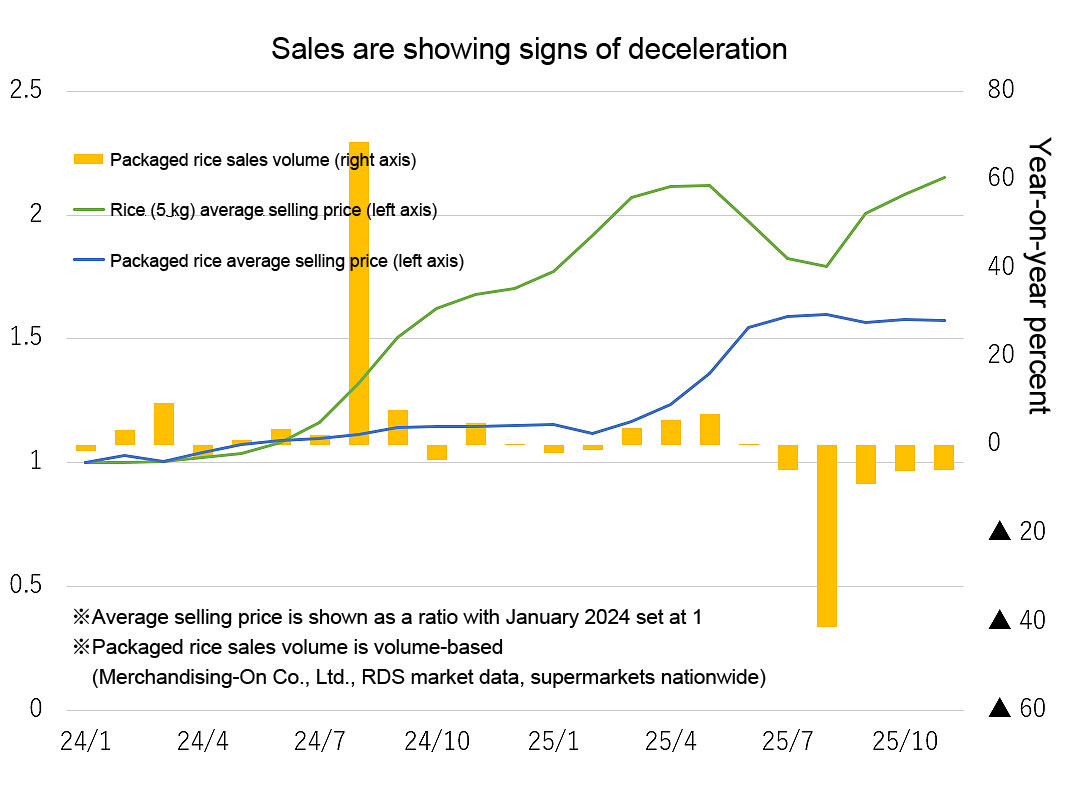
Furthermore, because rice prices rose to levels higher than expected, the industry carried out several price revisions from the end of last year through this autumn. The average selling price has recently risen to more than 1.5 times the level at the beginning of last year, reaching a level that even users who had previously purchased it for its cost performance and time performance now find difficult to afford.
Looking at POS data, sales in value terms have continued to grow due to the effects of price hikes, but partly as a reaction to last year, fatigue in volume sales has become increasingly noticeable. =Graph
Rice prices remain high, but some expect prices to collapse because of excess inventory in distribution channels, making the price outlook after the start of the new year difficult to read.
Although demand for packaged rice has temporarily been put under pressure by soaring selling prices, the market is still seen as having significant latent room for growth. Whether rice supply and prices move toward stability at an early stage is likely to have a major influence on the direction of the market.