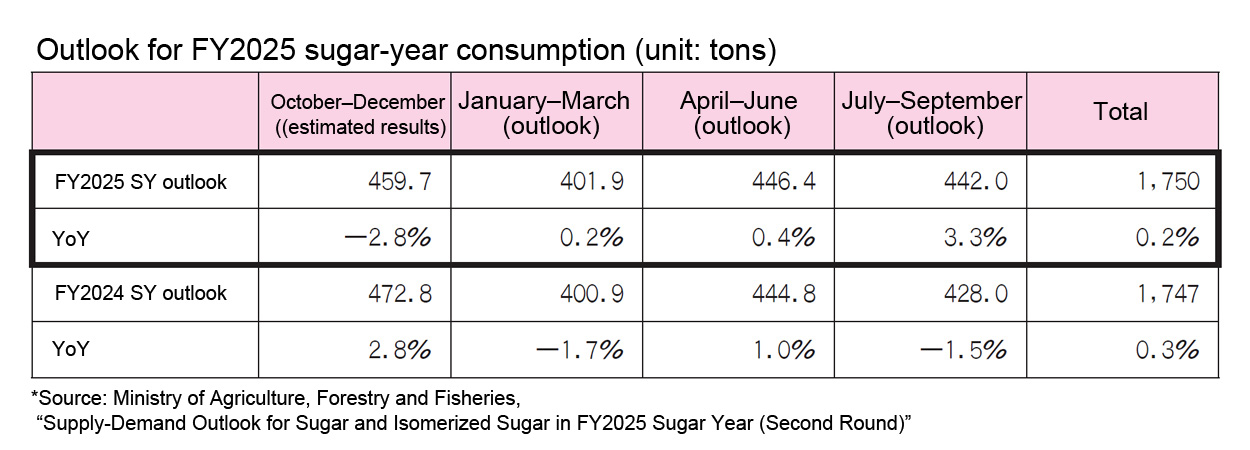
In the Ministry of Agriculture, Forestry and Fisheries’ sugar supply-demand outlook (December 2025), domestic sugar consumption in the FY2025 sugar year (October 2025 to September 2026) was left unchanged from the outlook announced last September at 1.75 million tons.
Last year, there was increased inbound demand and special demand driven by the Osaka-Kansai Expo, but FY2024 sugar consumption ended at 1.747 million tons, a slight increase from the previous year. Industrial demand was firm, but household demand continued to remain weak amid declining consumer sentiment due to higher prices and a decrease in home cooking. This year as well, positive and negative factors are expected to continue to offset each other, and sugar consumption is expected to remain almost flat.
Estimated results for the first quarter of FY2025 sugar year (October to December 2025) came to 459,700 tons, down 2.8% from the same period a year earlier. In October alone, there was a reactionary decline after a sharp rise in October of the year before last, and November also posted a steep drop of 5.2%, continuing the difficult trend.
Last November, sugar refineries lowered the price of industrial refined sugar for the first time in about seven years. As the lower prices made their way into wholesale market prices, buyers on the demand side appeared to hold back purchases. In addition, a major beverage manufacturer raised prices on PET bottle drinks last October. The impact of shipment adjustments driven by a thrift-oriented mindset may also have been a factor.
The first quarter corresponds to the peak demand season for sugar, covering souvenir sweets for year-end and New Year homecomings and gifts, Christmas, and osechi dishes. Although the results fell below the initial first-quarter outlook of 470,900 tons, raising concerns about a downward revision on an annual basis, the forecast of 1.75 million tons was left unchanged.
From the second quarter onward, there will be no special-demand events like last year’s Osaka-Kansai Expo, but positive and negative factors are still expected to remain in balance. At present, the outlook is for a near-flat annual level of 1.75 million tons.
Going forward, a rebound from special factors such as the first-quarter price cuts for refined sugar and the price increases for PET bottle drinks can be expected. On the other hand, there are concerns about the impact of deteriorating relations with China on inbound tourism, but the yen has been weakening further, and it is difficult to imagine inbound demand suddenly cooling off all at once.
“Higher food prices are a negative factor, but the economy is generally on a recovery trend. Real income for wage-earning households has also increased for three consecutive months. While rice prices remain high, demand for bread and pasta is growing, which works positively for sugar demand, and the restaurant industry is also continuing to trend upward,” said the Ministry of Agriculture, Forestry and Fisheries’ Agricultural Production Bureau, Regional Crops Division.
In addition, with the price revision for industrial refined sugar shipments last November, wholesale market prices in the distribution market (Nikkei newspaper, Tokyo, per kg) were lowered by about 3% to 241–243 yen for granulated sugar and 244–246 yen for granulated sugar.
While uncertainties remain, such as the price of raw sugar and exchange-rate trends, the price revision could become a positive factor amid continued competition with alternative sweeteners such as high-intensity sweeteners and isomerized sugar.