According to data released by the Ministry of Agriculture, Forestry and Fisheries on February 3, the export value of agricultural, forestry, and fishery products and foods for January–December 2025 was 1.7005 trillion yen, up 193.4 billion yen (12.8%) year on year. All major destination countries and regions posted increases over the previous year, marking a record high for the 13th consecutive year.
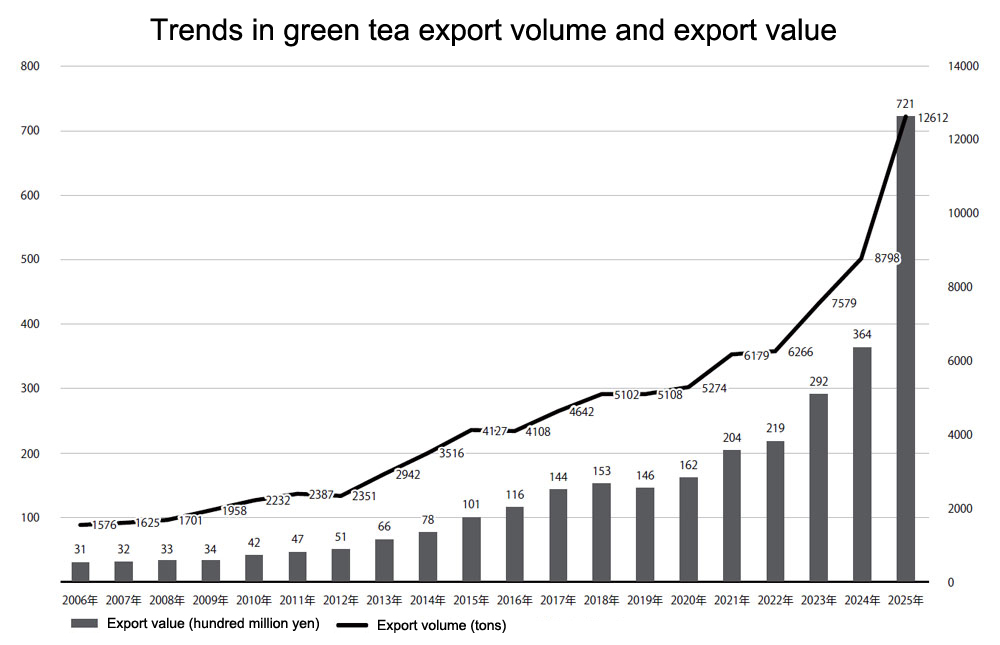
Among these products, green tea showed a particularly high growth rate, with export value rising by 35.7 billion yen (98.2%) year on year to 72.094 billion yen. Of this, powdered teas including matcha accounted for 69% of export volume and 84% of export value. Driven by growing health consciousness and heightened interest in Japanese cuisine, overseas demand has surged, especially for matcha used as an ingredient in lattes, sweets, and other foods, with notable increases in exports to the U.S., Europe, and ASEAN.
According to the Japan Food Overseas Promotion Center (JFOODO), the unit price per weight for exports to the U.S. is five times higher than that of Chinese green tea, and the “Uji/Kyoto” brand has gained recognition, leading to high-priced transactions as high-quality matcha.
In April last year, the Ministry of Agriculture, Forestry and Fisheries revised the “Basic Policy for the Promotion of the Tea Industry and Tea Culture,” encouraging farmers to switch to tencha, the raw material for matcha, with the dual aim of expanding domestic production and exports. It is said that this has had a significant impact. With health consciousness on the rise, the trend toward prioritizing quality has strengthened, and recognition of matcha as a product synonymous with Japanese origin also appears to be increasing.